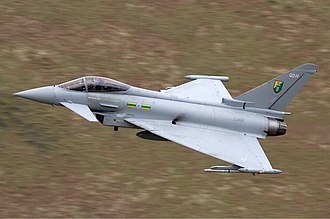
The Eurofighter Typhoon is a twin-engine, supersonic fighter jet built by a European team including Airbus, BAE Systems, and Leonardo. Originally made for air superiority, it now handles strike missions too. Developed after the Cold War, it entered service in 2003 and is flown by the UK, Germany, Italy, Spain, and several others. The Typhoon saw combat in Libya in 2011 and now serves as a key part of Europe’s air defense. It can carry advanced weapons like the Storm Shadow and Brimstone missiles, making it a versatile and powerful aircraft in modern warfare.
The Eurofighter Typhoon was born out of a shared vision in the 1980s to create a new-generation European fighter jet. Early concepts began in the UK and West Germany as each country sought replacements for older aircraft like the Jaguar and Tornado. In 1983, the UK, Germany, Italy, France, and Spain launched the Future European Fighter Aircraft (FEFA) program. However, France split off to develop its own aircraft (which became the Dassault Rafale), while the remaining nations pushed forward with what would become the Typhoon. The British Experimental Aircraft Programme (EAP) flew in 1986 and heavily influenced the Typhoon’s final design — with its cranked delta wings, canards, and twin engines. The Eurofighter consortium was officially formed in 1986, and work was split across several nations. Over time, the aircraft evolved to meet both air superiority and ground-attack roles. The first prototypes flew in the early 1990s, and after long delays and political wrangling, the Eurofighter Typhoon entered service in 2003. It remains one of Europe’s most advanced fighter jets.
Germany’s financial strain from reunification made Chancellor Helmut Kohl consider canceling the Eurofighter project. In 1991, Defence Minister Volker Rühe pushed to pull out and focus on a cheaper, lighter plane using Eurofighter tech. But because of the huge development costs, jobs tied to the project, and strict agreements, Kohl couldn’t back out. Past leaders had locked Germany in with heavy penalties. By 1995, workshare disputes emerged. Originally, the split was set based on orders: UK 33%, Germany 33%, Italy 21%, Spain 13%. But all countries cut their orders—UK from 250 to 232, Germany from 250 to 140, Italy from 165 to 121, Spain from 100 to 87—so the fair workshare should’ve changed to roughly UK 39%, Germany 24%, Italy 22%, Spain 15%. Germany wasn’t willing to lose that much work, leading to negotiations. In 1996, Germany agreed to buy 40 more jets, adjusting the split to UK 37.4%, Germany 29%, Italy 19.5%, and Spain 14%. At the 1996 Farnborough Airshow, the UK confirmed funding for production, and by December 1997, all four nations officially signed the contract to start building the Eurofighter.
The Eurofighter prototype made its first flight in Bavaria on March 27, 1994, piloted by DASA’s lead test pilot Peter Weger. In December 2004, the Typhoon IPA4 underwent three months of cold-weather testing in Sweden to check its performance in temperatures ranging from −25 to 31 °C. Later, on January 16, 2008, the fully equipped Tranche 2 model, IPA7, took off for its maiden flight from EADS’ Manching airfield.
In 2000, the UK picked MBDA’s Meteor missile for the Typhoon, targeting service by 2011. By 2002, France, Germany, Spain, and Sweden joined a $1.9 billion contract for Meteor on Eurofighter, Rafale, and Gripen jets. Delays pushed the in-service date to 2012. Budget limits in 2011 slowed upgrades, especially for air-to-ground weapons like the Storm Shadow missile. Tranche 3 added better electronic countermeasures, new jammers, and advanced missile warning systems. The upcoming AESA radar will enhance defense and cyber capabilities. BriteCloud, a disposable jammer, is being considered. Eurojet sought funding to test thrust vectoring for better agility. In 2014, BAE tested conformal fuel tanks that extend Typhoon’s range by 25%. BAE’s Striker II helmet adds color display, seamless night vision, and head tracking, plus 3D audio and comms. In 2015, BAE studied a launcher for multiple weapon types on one pylon. Airbus’ 2015 Aerodynamic Modification Kit boosted wing lift by 25%, improving turn rates and maneuverability without sacrificing speed. In 2016, Finmeccanica showed a friend-or-foe system to reduce friendly fire, now being considered by NATO.
Germany plans to replace the Eurofighter Typhoon with the New Generation Fighter (NGF), a cutting-edge aircraft being co-developed with France and Spain as part of their joint Future Combat Air System (FCAS) initiative. Meanwhile, the UK, in partnership with Italy and Japan, is advancing the Global Combat Air Programme (GCAP)—a next-generation, sixth-generation fighter jet designed to succeed the Typhoon in both the Royal Air Force and the Italian Air Force. GCAP is a core part of the UK’s broader Future Combat Air System, aimed at maintaining air superiority in the decades to come.
| Weapon | Type | Purpose | Range |
|---|---|---|---|
| Mauser BK-27 | Internal Cannon | Close Combat / Strafing | Up to 2 km |
| AMRAAM | Air-to-Air Missile | BVR Interception | Up to 100+ km |
| IRIS-T | Air-to-Air Missile | Dogfighting | Up to 25 km |
| Storm Shadow | Air-to-Ground Cruise Missile | Deep Strike | Up to 560 km |
| Brimstone | Air-to-Ground Missile | Armored Targets | Up to 20 km |
| Paveway IV | Laser-Guided Bomb | Precision Strikes | Up to 15 km |